For over a year, IT infrastructure hardware costs have skyrocketed, and storage infrastructure has been along for the ride. In 2026 alone, contract prices for NVMe-based triple-level cell (TLC) devices have jumped over 100%1. While many IT leaders have responded by extending the useful life of their existing storage or purchasing extended support contracts, that strategy can only cover existing data. With data continuing to grow by 30% a year or more, IT must procure more storage to continue to support the business. The elevated price of storage makes a compelling case to revisit storage strategy and search for lower-cost alternatives for new storage requirements or for storage truly at the end of its useful life.
A new five-year total cost of ownership (TCO) study sponsored by Broadcom and written by Signal65 finds that VMware vSAN, running the Express Storage Architecture (ESA) in VMware Cloud Foundation (VCF) 9.0, costs up to 62 percent less than an external Fibre Channel (FC) SAN for the same workload capacity2. The savings come from lower capital expenditure on storage hardware and reduced administrative overhead. The savings flow from two structural differences: vSAN’s server-based storage can be procured for a fraction of the cost of an array’s storage, and vSAN can be managed by systems administrators; it doesn’t require a dedicated storage administrator.
Signal65 Performed a Rigorous TCO Analysis with Lab-based Testing for Operational Costs
Signal65, an independent analyst and lab validation firm, compared two storage approaches commonly deployed in VMware environments: VMware vSAN ESA and an external FC SAN. Both ran in the same test infrastructure on VCF 9.0, with vSAN configured to use ESA. The study modeled two environment sizes to represent realistic mid-market and large enterprise deployments.
For the capital expenditure measurements, Signal65 sourced prices for both vSAN and external, fibre channel arrays from public price lists. They combined prices from multiple array and server vendors to smooth out price distortions from any single vendor. Finally, they built a quote based on two modeled environments. The larger, enterprise environment included two sites with 64 hosts in 8 clusters, 6,400 VMs, and 2,148 TB of raw storage. Signal65 measured administrative time for common storage tasks in a lab environment using VMware Cloud Foundation 9.0 with VMware vSAN storage, and the same VCF environment with an external, controller-based array.
vSAN Saves Up to 62% in Capital Costs
At list pricing with equal raw capacity, vSAN carried the lower five-year capital cost in both environments. In the larger environment with servers from Tier-1 OEM vendors, vSAN cost 39.5 percent less2. Sourcing vSAN hosts through build-to-order channels, an option with no equivalent for an external array, widened the savings 61.8 percent in the larger environment.
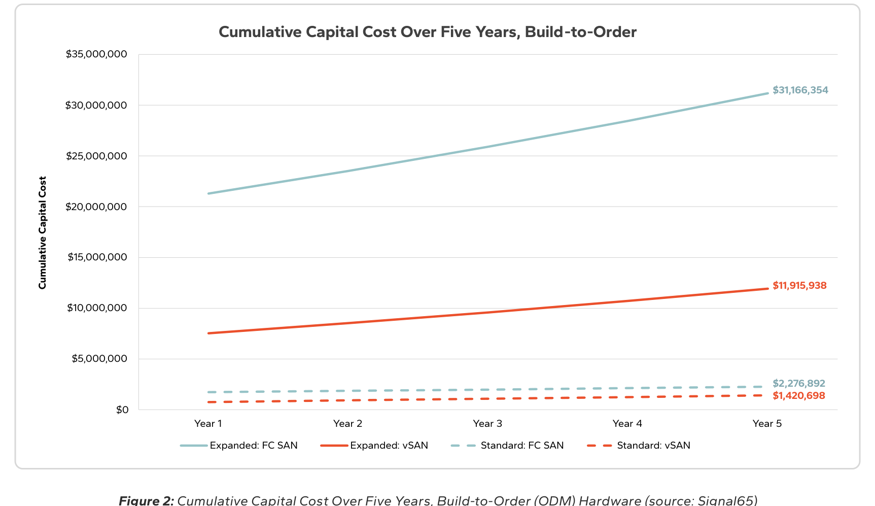
Cumulative Capital Cost Over Five Years, Build-to-Order ODM Hardware. Line chart comparing vSAN versus FC SAN cumulative capital costs across Standard and Expanded environments over five years, showing vSAN consistently lower in both deployment sizes.
Figure: Cumulative Capital Cost Over Five Years, Build-to-Order (ODM) Hardware (Source: Signal65)
The primary cost driver differs by environment size. In the larger environment, both platforms run VCF, so licensing is close to parity. The gap there is almost entirely storage hardware, which accounts for roughly 70 percent of the total cost difference2.
Operational Cost Savings
Signal65 measured administrative time across three operational areas: initialization and setup, ongoing operations including provisioning, capacity management, and performance management, and recovery and availability including snapshots, business continuity, disaster recovery, and device failure.
vSAN required less administrative time in both environments and didn’t need a separately designated storage administrator for the modeled tasks. Over five years, operational cost was 36 percent lower in the larger environment. The most striking savings came in device failure scenarios, where vSAN required 77 percent less in the larger environment2. Provisioning and maintenance tasks were 37 percent faster, and deployment and expansion were 42 percent faster2.
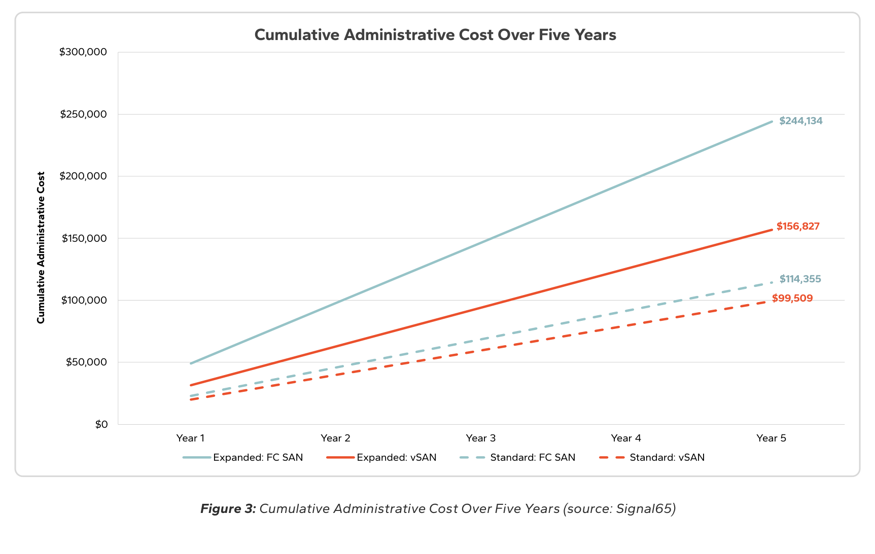
Cumulative Administrative Cost Over Five Years. Line chart comparing vSAN versus FC SAN cumulative administrative costs across Standard and Expanded environments over five years, showing vSAN consistently lower in both deployment sizes.
Figure: Cumulative Administrative Cost Over Five Years (Source: Signal65)
The primary drivers of operational cost for both approaches came from storage planning and remediation, which spans capacity and performance management. vSAN required less time in both areas, and eliminating the dedicated storage administrator role further reduced costs.
Combined Five-Year Cost of Ownership
When capital and operational costs are combined, vSAN’s advantage holds across every scenario. The percentage savings range went as high as 61.6 percent in the larger environment with build-to-order sourcing2. The savings grow with scale: mid-market deployments see a meaningful advantage, and large enterprise deployments see savings that can fundamentally change an infrastructure budget.
Environment Sourcing vSAN Advantage2
Larger Tier-one OEM 39.5%
Larger Build-to-order (ODM) 61.6%
The build-to-order scenario shows the largest savings at 61.6% in the larger environment. These percentages represent the proportional savings relative to the FC SAN baseline, and they hold regardless of the actual discounting an organization negotiates on either platform.
What This Means for You
For IT leaders evaluating storage strategies for their VCF environments, the Signal65 study provides independent, lab-validated evidence that hyperconverged infrastructure (HCI) built on vSAN can meet enterprise requirements at lower five-year cost and with lower operational overhead than external FC SAN storage. The savings scale linearly, so as the storage environment expands, customers should experience similar savings. The larger environment reveals the broader impact: vSAN’s architecture eliminates the need for proprietary arrays, FC fabric, and dedicated storage administrators. At build-to-order pricing, the savings reach levels that can fundamentally change an organization’s infrastructure budget.
For systems administrators, the operational findings matter directly. The ESA design simplifies day-to-day management through its single storage pool model, integrated, policy-based data protection, and simplified lifecycle management. The 77 percent reduction in device failure remediation time means less stress and faster recovery2.
Next Steps
If you want to dive deep into the study, you can view a free copy here.
If you want to learn more about VMware vSAN and what it can do for your VCF environment, visit our website.
Sources
1. Enterprise SSD Contract Price 1Q26. TrendForce, 27 Jan. 2026, www.trendforce.com/research/download/RP260128FF.
Enterprise SSD Contract Price 2Q26. TrendForce, 24 Apr. 2026, www.trendforce.com/research/download/RP260427NK.
Enterprise SSD Contract Price 3Q26. TrendForce, 29 Jul. 2026, www.trendforce.com/research/download/RP260728RU.
2. Fellows, Jonathan. Signal65. “Financial and Operational Impact of VMware vSAN ESA vs. External Fibre Channel Storage.” Lab Insight Report, 2026.
Discover more from VMware Cloud Foundation (VCF) Blog
Subscribe to get the latest posts sent to your email.