DVD Store, an open source database testing toolkit, has been widely used since it was originally released in 2005. It can be run on SQL Server, Oracle, PostgreSQL, and MySQL databases. DVD Store simulates an online store where users log in, browse, review, rate, and purchase DVDs. It uses many common database features including stored procedures, indexes, foreign keys, full text search, multi-join complex queries, and transactions.
DVD Store was originally developed and designed to be a database workload that is CPU intensive. It has also always included parameters that can be used to alter this CPU-intensive profile, allowing for network-, disk-, and even memory-intensive profiles.
Examples of these profiles have now been included and explained in the main DVD Store GitHub repository: https://github.com/dvdstore/ds35/tree/main/workload_profiles
Testing was done with these workloads to provide context to how much they change workload behavior as compared to the default CPU-intensive workload. All tests were done with a single VM running on a VMware Cloud Foundation (VCF) ESX 9.0 server. The VM was running Windows Server 2022 with SQL Server 2022.
The performance metrics used are all from the ESX host perspective and were captured using esxtop (similar to linux top, but for ESX and collects many more metrics).
- CPU Utilization – CPU Utilization of the ESX host
- Disk I/O per second (IOPS) – Disk read and write operations for ESX host
- Mb received per second (Mb Rec/s) – Megabits received per second via network
- Mb sent per second (Mb Sent/s) – Megabits sent per second via network
- Active Memory (ActiveMem) – Memory touched (or active) recently
Relative Changes in Key Metrics with Workload Profiles
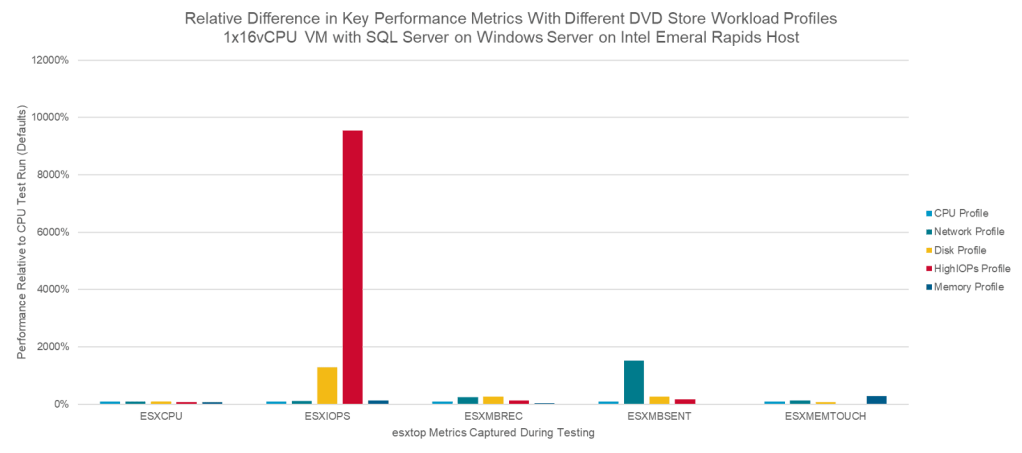
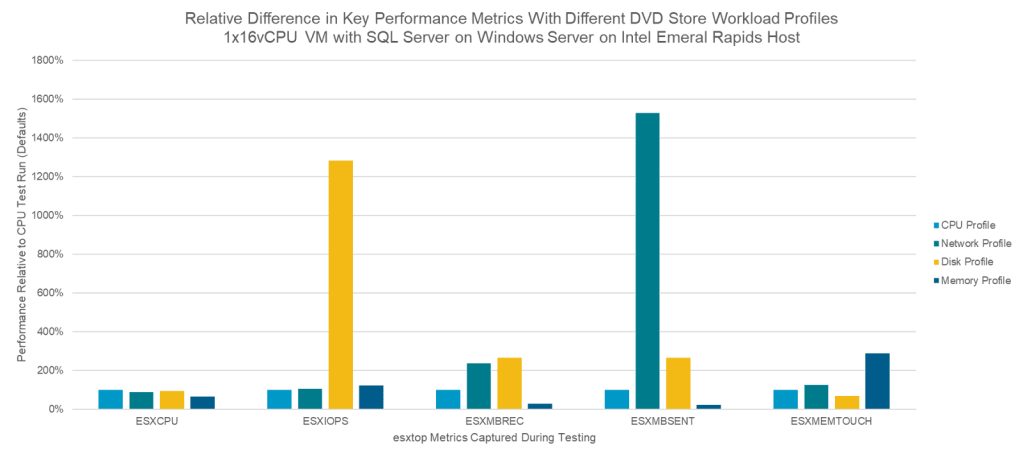
To baseline the key metrics, tests were run with the CPU-intensive profile. Tests were then run with the disk-, highIOPs-, network- and memory-intensive profiles and the key metrics were compared against this baseline. The graphs below show the relative differences across these key performance metrics as compared to the baseline CPU-intensive profile. The first graph shows all workload profiles; the second one excludes highIOPS so that the other relative differences can be seen more easily.
In summary, in the key metric for each respective workload profile significant increases are seen:
- Disk-intensive profile produces 13x more IOPS
- High IOPS profile produces 95x more IOPS, 7x more IOPS than disk-intensive
- Network-intensive profile produces 15x more Mb sent per second
- Memory-intensive profile causes 2.9x more active memory
Details for all workload profiles are located in ds35_workload_profiles.txt on the DVD Store GitHub project. Specific DVD Store parameters and database configuration details as well as brief explanations are included.
Discover more from VMware Cloud Foundation (VCF) Blog
Subscribe to get the latest posts sent to your email.