
Is your organization grappling with issues like lack of granular data on resource allocation, usage and performance information spread across multiple tools and uncertainty when it comes to predicting future capacity needs?
In today’s fast-paced IT environment, infrastructure teams are constantly balancing performance, cost, and growth. Capacity management is often seen as a purely operational task, but when executed proactively, it transforms into a powerful business enabler. The need for streamlined capacity management stems from the following crucial reasons:
- Reliability and performance: By proactively addressing resource needs, capacity management helps ensure stable, high-performing systems and avoids potential outages or slowdowns.
- Cost control: Effective capacity management prevents excessive expenditure on hardware, software, or cloud resources. This allows organizations to control costs and adhere to their budget while simultaneously guaranteeing readiness for future expansion.
- Business scalability and resilience: capacity management supports growth by ensuring IT systems can handle new users, services, or spikes in demand, and provides the flexibility to respond to disruptions.
- Productivity and customer satisfaction: capacity management enhances satisfaction and reduces downtime by ensuring reliable access to services and resources for both employees and customers.
Organizations usually consume capacity related data in the following ways:
- Dashboards and Reports: Most cloud admins use dashboards to visualize key metrics—utilization, performance, trends—and receive automated alerts for issues.
- Data Analysis Tools: Capacity analysts and planners rely heavily on analytics tools to forecast trends, create recommendation reports, and model scenarios.
- Meetings and Collaboration: Decisions are often made through cross-functional discussions, where information from dashboards and reports is presented for review.
- Automated Alerts and Notifications: Systems administrators and managers act on alerts about bottlenecks or performance degradation, using this information for timely interventions.
- Strategic Reviews: Organizational leaders can use consolidated reports and scenario models to know what is happening with infrastructure capacity and decide on investments and expansion opportunities
The challenges of unpredictable resource requirements and lack of a unified view into consumption, demands a cohesive and intelligent solution. This is where VMware Cloud Foundation helps. VMware Cloud Foundation (VCF) is a unified, software-defined platform that integrates compute, storage, networking, and management into a single solution to help organizations build, operate, and secure a private or hybrid cloud environment.
VMware Cloud Foundation allows you to:
- Assess your Capacity Needs
- Gain capacity visibility across your entire cloud stack.
- Leverage AI-driven, predictive analytics for capacity assessments.
- Determine the remaining time before infrastructure capacity is depleted.
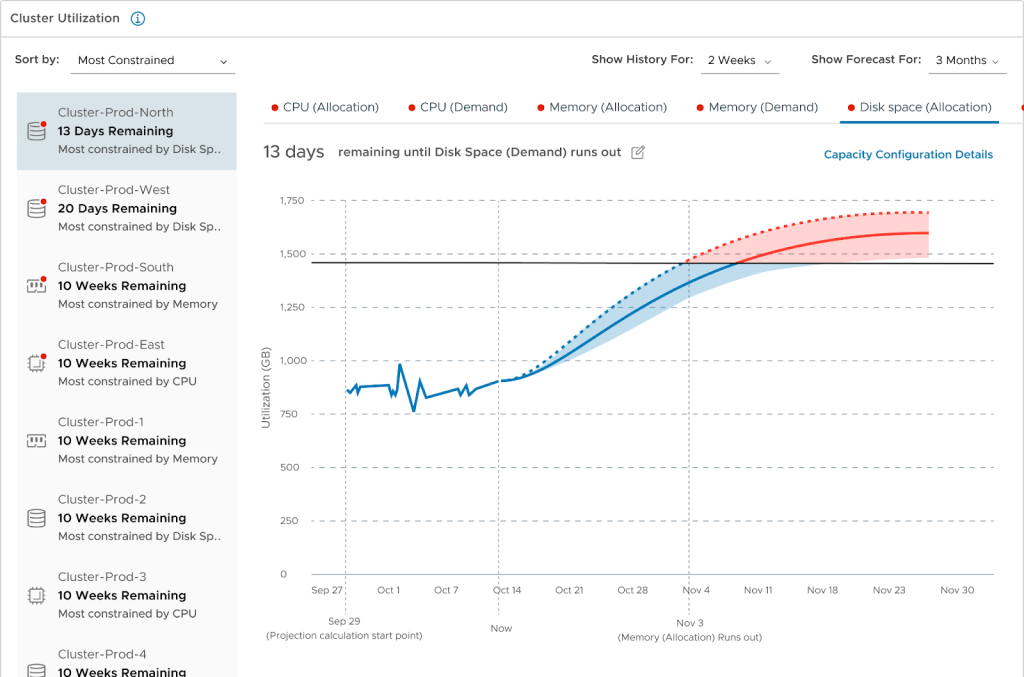
Figure 1: Capacity forecast showing cluster utilization
- Optimize your Resources
- Rightsize virtual machines based on actual utilization patterns.
- Reclaim unused or idle resources (e.g., powered-off or idle VMs, old snapshots, orphaned disks).
- Regularize optimization actions.
- Fine tune capacity management policies.
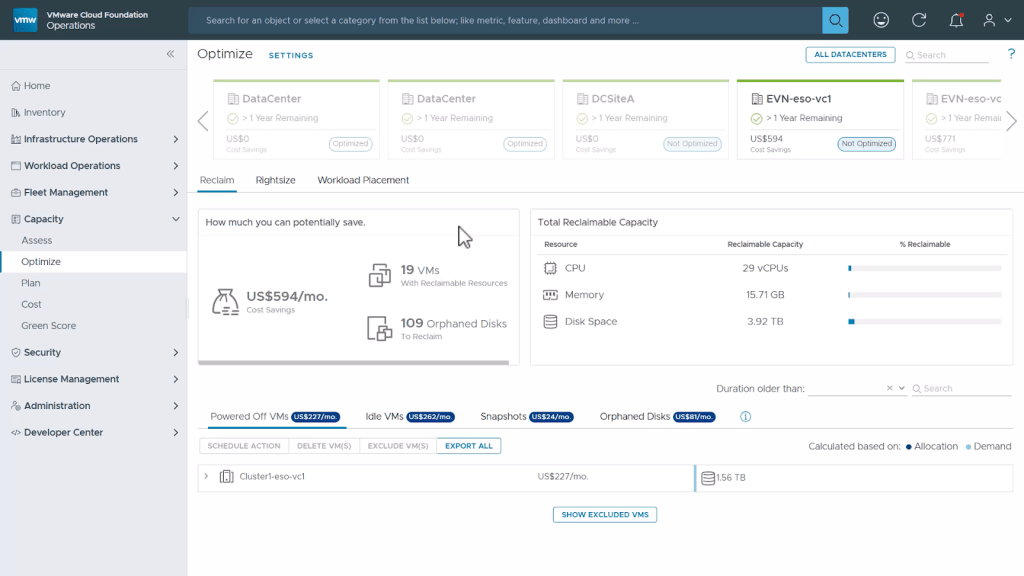
Figure 2: Resource reclamation opportunities
- Plan your capacity requirements:
- Add or remove resources for new workloads.
- Understand the capacity impact of infrastructure changes.
- Determine the cost implications of capacity adjustments.
- Model real-world scenarios to gain capacity and cost insights.
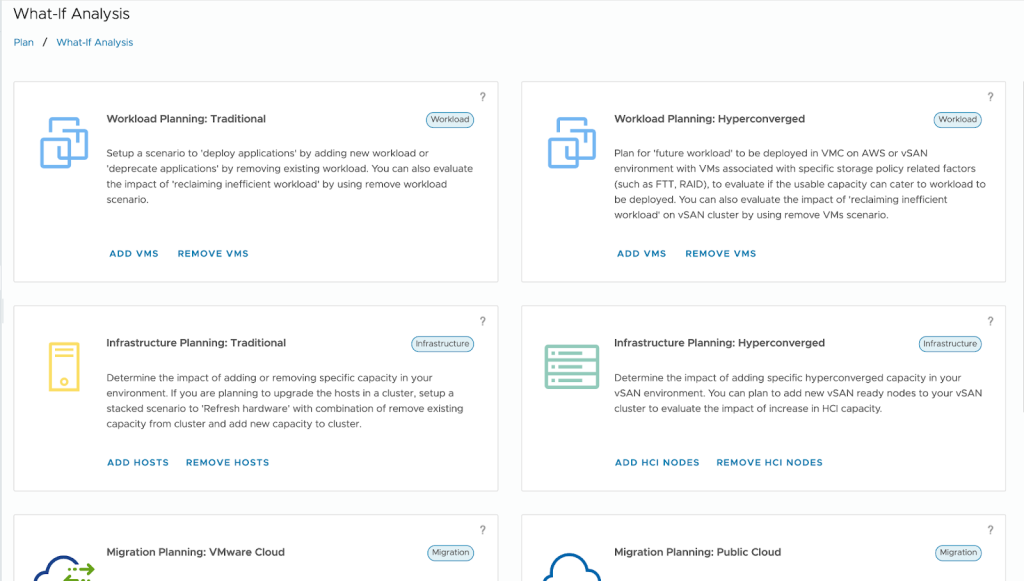
Figure 3: Capacity planning scenarios
With VMware Cloud Foundation 9, we have advanced the platform’s capacity management capabilities in the following ways: :
- Ability to exclude anomalous time ranges from capacity projections
Capacity forecasts can be skewed by aberrations in utilization patterns caused by unusual incidents like network outages or security DDoS attacks. Metric values resulting from this unusual behavior can now be excluded from influencing those capacity forecasts.
- Create exceptions for Storage in capacity calculations
Capacity status is computed based on the most constrained resources. As storage utilization is usually high, capacity status often shows it is critical since storage is the most constrained and CPU and memory do not get reflected on priority. To avoid this situation users can now exclude storage from capacity calculations.
- Addition of Clusters in What-if Scenario Planning
The newest VMware Cloud Foundation release enhances its What-If Scenario Planning. This now includes the ability to visualize how adding new Virtual Machines (VMs) affects new Clusters.
Conclusion
VMware Cloud Foundation not only helps you achieve financial savings, but it also elevates your system health and performance while streamlining operational efficiency.
By identifying and addressing wasted resources, organizations can realize substantial savings. This fosters a culture of cost-accountability, encouraging teams to avoid the “overprovisioning” that leads to massive resource inefficiency.
Embedding capacity management into daily operations, IT teams can transition from simply maintaining infrastructure to actively driving performance, cost efficiency, and business value.
Capacity Management now is a lot more strategic with resource planning going beyond the traditional spreadsheets. VMware Cloud Foundation manages your capacity needs while aligning with business objectives.
You can get more information about capacity management in the following deep dive blog. To learn more about VMware Cloud Foundation Operations check out our webpage.
Discover more from VMware Cloud Foundation (VCF) Blog
Subscribe to get the latest posts sent to your email.